The Sumerian Standard of Ur Shows Scenes of:
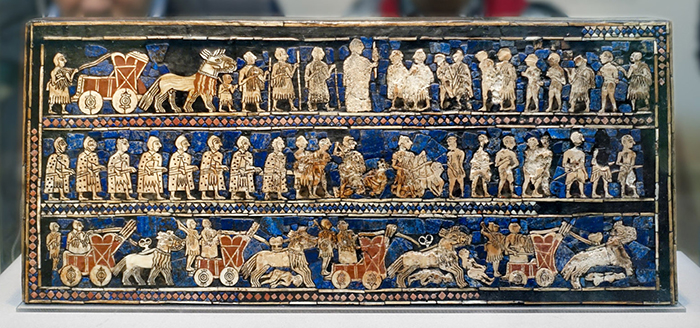
The so-called War Side of the Standard of Ur shows three registers of battle scenes with the earliest representations of a Sumerian army and the aftermath of the fight McDonald 2013. Thats not so different than this object that were looking at thats nearly 4500 years old an object known is the Standard of Ur which comes from the city-state of Ur which is now in present day Iraq.

ウルのスタンダード Mesopotamia Sumerian Ancient Sumer
All the scenes are colourfully illustrated in pieces of red limestone shell and lapis inlays McDonald 2013.

. The great sphinx is associated with which pharaohs pyramid. The Standard of Ur is a wonderful example of Mesopotamian artistic achievement that reveals a wealth of information about one of the worlds great ancient civilisations. Create an account Like this lesson Share.
The British Museum 2015. The captives are naked and their bodies have wounds with blood gushing from them. Woolley though it might have been mounted on a pole and carried hence its name.
The Sumerian Standard of Ur shows scenes of what. Sumerian soldiers wearing flounced skirts lead prisoners of wars. The Sumerian standard of Ur shows scenes of.
One side shows a war scene. Standard of Ur - A glimpse of War. The frontispiece of The Fifth Vision of Hildegard of Bingen 3213 shows Hildegard of Bingen __________.
A Sumerian army with wheeled waggons and infantry charges the enemy. The Ishtar Gate was built under whos rule. Standard of Ur War Introduction In the largest of all the stone-built royal tombs which had been entered by robbers and most thoroughly plundered there remained only one corner of the last chamber to be cleared and we had given up expectation of an finds when suddenly a loose bit of shall inlay turned up and the next minute the foremans hand carefully brushing away the earth.
This is a detail of the so-called War Scene of the Standard of Ur. There two main sides to the Standard one side depicts a battle scene while the other seems to represent a society in relative peace. There is additional proof that this is indeed the captured enemy king.
This decorated piece is from one side of the wooden box known as the Standard of Ur found by Leonard Woolley at a royal burial site in Ur in 1922. Prisoners are brought before a larger individual who is accompanied by guards and has his own waggon waiting behind him. Leonard Woolley during excavations at ancient Ur modern Tell al-Muqayyar in southern Mesopotamia south Iraq.
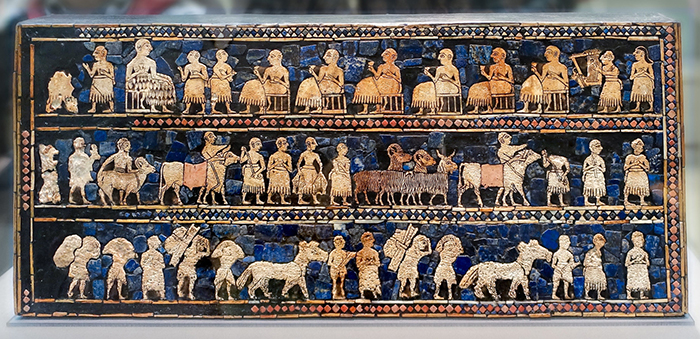
The Standard of Ur is a box the two large sides of which show aspects of life in early Mesopotamia. As explained in The Standard of Ur. The purpose of the object remains unknown.
This detail is the right end of the top register. A battle standard needs to be recognizable from a distance so it should have only one simplified symbol not the intricate tableau seen on the Standard of Ur. The Standard of Ur is a box the two large sides of which show aspects of life in early Mesopotamia.
King the Sumerian king and the enemy kings all carry standards. Proclaimed his place in history. This object was discovered by the archaeologist C.
It was possible to decipher hieroglyphics because of ____ The rosetta stone. In Mesopotamia really the birthplace of civilization and Ur is one of the great early cities. It was possible to decipher hieroglyphics because of ____ The rosetta stone.
Made out of red limestone shell and lapiz lazuli this one shows a victorious king triumphant after a border skirmish. This is a detail of the so-called War Scene of the Standard of Ur. On the Standard of Ur the presence of a battle standard is used as an artistic device identify a king.
A Sumerian artefact the Standard of Ur was created in the 3rd millennium BC during the first dynasty in the city-state of Ur the present day Iraq. Explore our library of over. Woolley though it might have been mounted on a pole and carried hence its name.
The Standard both through its depictions and physical construction reveals a great deal about the organization of Early Dynastic Sumerian society. This enigmatic artifact is a small trapezoidal box 85 inches high by 195 inches long and was probably the decorated soundbox of a musical instrument. The bull leapers fresco from knossos is ___ scene.
The Sumerian standard of Ur shows scenes of. They wear leather head caps and cloaks as well as. The enemy king pictured above proudly carried aloft his battle standard going into.
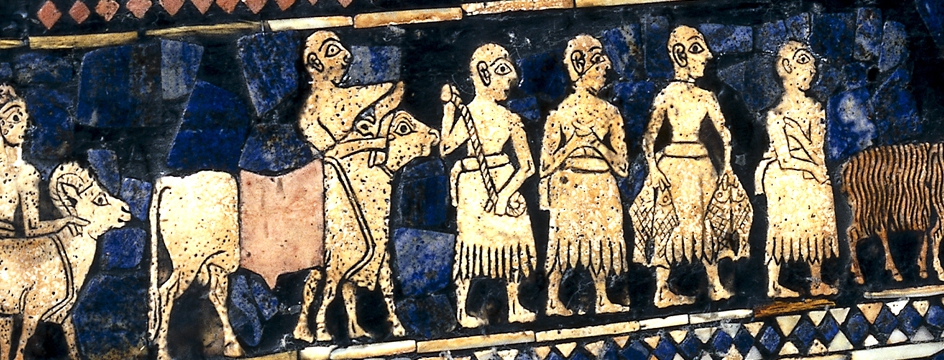
The Standard of Ur decorated on four sides with inlaid mosaic scenes made from shell red limestone and lapis lazuli set in bitumen. This detail is part of the left half of the middle register. The great sphinx is associated with which pharaohs pyramid.
The purpose of the object remains unknown. Others think it may be the sounding box of a lyre. The peace panel shows the other side of Sumerian life - a banquet with a musician playing the a lyre type instrument.
The Ishtar Gate was built under whos rule. The Emperor Constantines triumphal arch ___________. Ur located in Mesopotamia widely considered the birthplace of civilization was one of the earliest cities in the world and one of the most significant of this time.
The Sumerian Standard of Ur shows scenes of. Create an account to start this course today Try it risk-free for 30 days. Its full purpose is not definitely known but it clearly records the king and his court along with the spoils of military victoryThe box was found in one of the largest chambers at the Royal Cemetary at Ur.
A Sumerian battle standard probably had crossed battle axes for instance or perhaps Anzud the lion-headed eagle a symbol of war much like the mythological creature shown on the Roman battle standard pictured above. And The Standard of Ur. These scenes are from what is usually called the war panel.
Why is it called the Standard of Ur. Here six Sumerian soldiers stand and stride to the right. The Standard of Ur is a set of mosaic scenes that show powerful images of battle and regal life and that remain remarkably well preserved.

The Standard Of Ur C 2500 B C Ancient Mesopotamia Ancient Sumerian Ancient Near East

メソポタミア ウルのスタンダード Ancient Sumerian Cradle Of Civilization Sumerian
Teaching History With 100 Objects The Standard Of Ur
Standard Of Ur And Other Objects From The Royal Graves Article Khan Academy

Pin En Ap Art History

The Standard Of Ur Is Actually A Hollow Box Decorated With Mosaics Of Lapus Lazuli Red Limestone And Shell Set In Bitumen Sumerian 26th Century Bce 4 Ancient Mesopotamia Art History Mesopotamia

Teaching History With 100 Objects The Standard Of Ur

The Sumerian King List Still Puzzles Historians After More Than A Century Of Research Ancient Near East Cradle Of Civilization Sumerian

Artifacts Of The Royal Cemetery Of Ur Ancient Mesopotamia Mesopotamia Ancient Artifacts

Pin Di Art Ancient Near East
Standard Of Ur And Other Objects From The Royal Graves Article Khan Academy

The Standard Of Ur Mesopotamia Mosaic The British Museum London England Mesopotamia Ancient Mesopotamia Ancient Sumer

The Standard Of Ur Decorated On Four Sides With Inlaid Mosaic Scenes Made From Shell Red Limestone And Lapis Lazu Art Through The Ages Art History Infantry

Standard Of Ur Front Back 2600 Bce Unknown Artist Mesopotamian Sumerian Wood Inland Shell Ancient Mesopotamia Ancient Sumerian Ancient Near East

The Standard Of Ur Art History Timeline British Museum Egyptian Painting

File War Side Of Standard Of Ur 26th Century Bc 38818504132 Jpg Wikimedia Commons
Sumerian Votive Figures From Eshunna 2900 2600 Bce Ancient Sumerian Ancient Near East Ancient History

Pin On Histroy

Southern Mesoptamia Mesopotamie Ancienne Civilisation Sumerien


Comments
Post a Comment